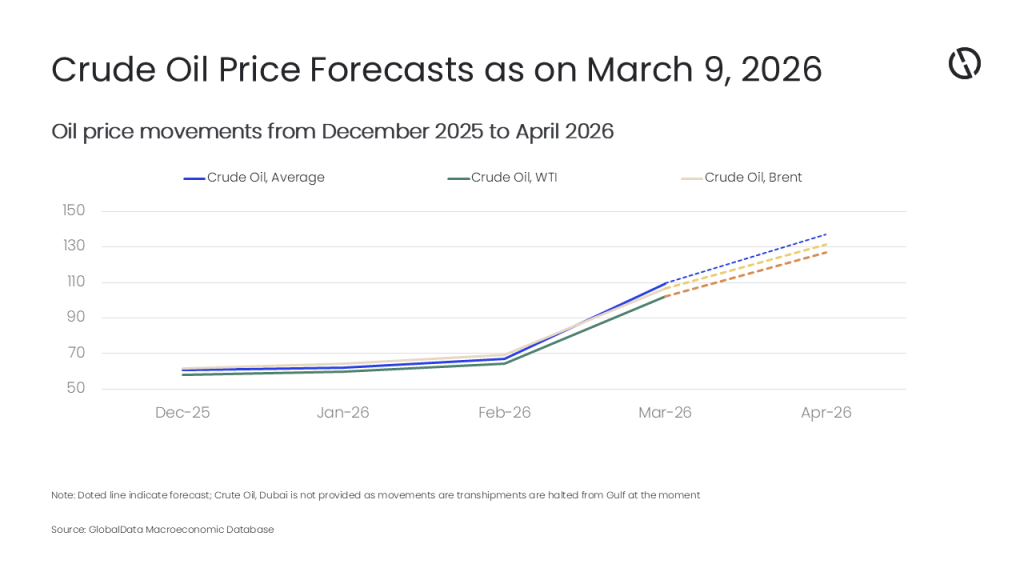
 Lagos — Following a surge in Brent and WTI prices above $119 a barrel on 9 March 2026, with Brent briefly nearing $120, its highest level in almost four years.
Brent crude futures climbed to a high of $119.50 per barrel and U.S. West Texas Intermediate (WTI) to $119.48 a barrel.
Jaison Davis, Economic Research Analyst at GlobalData, a leading intelligence and productivity platform, comments: “GlobalData’s 2 March 2026 analysis said the escalating Gulf conflict could push oil toward $100 a barrel by late March, mainly due to logistics disruptions and heightened maritime security risks that would restrict tanker movements and raise shipping insurance costs. Since then, the conflict has intensified faster than expected, triggering a new wave of volatility.
“The latest price spike indicates that the market is rapidly transitioning from pricing in a logistics disruption to factoring in a potential supply shock. Initially, traders reacted to maritime risks in the Strait of Hormuz, which raised shipping costs and delayed cargoes. However, recent developments suggest that actual production and export volumes across key Gulf producers are now at risk, fundamentally tightening global supply expectations.
“The pace at which oil prices moved from below $100 to above $115 highlights how thin the market’s spare capacity buffer has become. Even relatively small disruptions to Gulf production can trigger outsized price movements because the region accounts for a disproportionate share of globally traded crude.
“The current surge in prices also reflects the concentration risk within the global oil system. A large share of exports from Saudi Arabia, Iraq, Kuwait, and the UAE passes through the Strait of Hormuz, leaving global energy supply exposed to geopolitical disruptions in a single maritime corridor. Financial markets have already begun pricing in the broader macroeconomic consequences of the oil shock, including rising inflation expectations, currency volatility, and pressure on equity markets across energy-importing economies.
“Our updated outlook frames oil’s upside risks through three conflict-driven scenarios, with Brent pricing largely determined by the severity of logistics and supply disruptions in the Gulf.
“With global spare capacity relatively tight, even limited disruptions can trigger outsized and lasting price moves. If Brent remains above $110, inflation risks rise across importing economies, complicating central bank policy and reinforcing volatility.
“The speed of the price rally shows how quickly geopolitical risk can overwhelm traditional supply-demand fundamentals. Markets initially treated the Gulf escalation as a logistics disruption affecting tanker traffic, but recent developments indicate that actual export volumes are now under threat, forcing traders to price in a much larger risk premium.
“The key variable now is duration. If maritime flows through the Strait of Hormuz stabilize within weeks, oil prices may retrace some of their recent gains. However, if the conflict expands and export infrastructure remains under threat, the market could quickly move into a structural supply deficit, pushing prices significantly higher than current levels.
“At the same time, should GCC states, along with Turkey, manage to influence the US and international diplomatic channels toward de-escalation, markets may begin to unwind some of the current geopolitical risk premiums. Tanker flows through the Strait of Hormuz could stabilize, insurance and freight costs could moderate, and production cuts could be reversed, gradually pushing oil prices closer to pre-crisis levels. Residual volatility would likely persist, but a credible ceasefire or mediation effort could alleviate worst-case supply fears and ease pressure on energy-importing economies.
“Nonetheless, oil markets will remain acutely sensitive to developments in the Gulf region. Pricing dynamics are increasingly shaped by security conditions and the resilience of export routes through the Strait of Hormuz. Even with short-term stabilization in shipping, any lingering disruption to production, infrastructure, or tanker traffic risks sustaining elevated volatility, as well as renewed inflationary pressures for oil-importing countries.”
This article was originally posted at sweetcrudereports.com
Be the first to comment