Mkpoikana Udoma
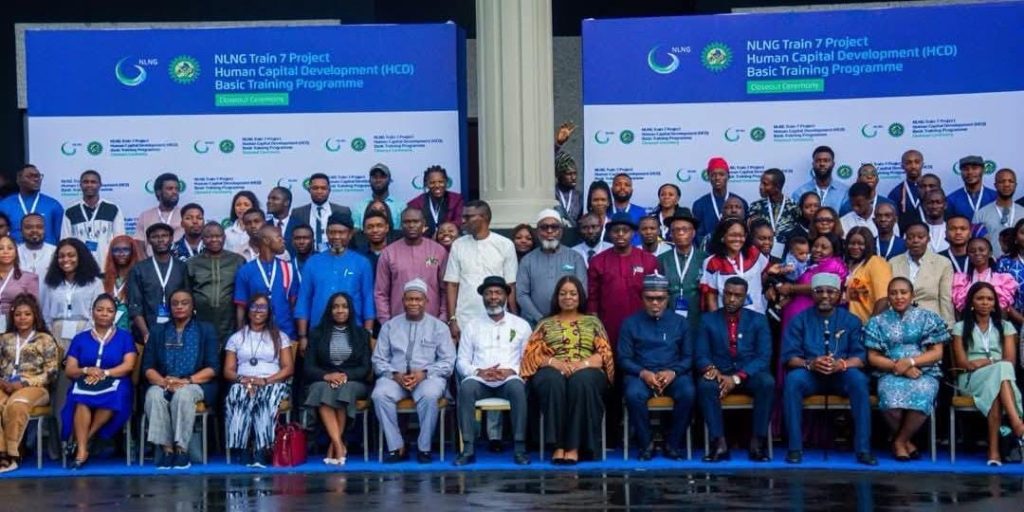
Port Harcourt — When 331 young Nigerians filed into the auditorium in Port Harcourt for their graduation from the NLNG Train 7 Human Capital Development, HCD, Basic Training Programme, the event was more than ceremonial, it was symbolic of a nation’s hunger for skilled talent in the oil and gas sector.
“This is your moment,” declared Dr. Sophia Horsfall, NLNG’s General Manager for External Relations and Sustainable Development. “We strongly believe that ‘the most valuable of all capital is human capital,’ and that is why NLNG continues to invest in people, skills, and the future.”
For a sector seeking stability, innovation, and continuity, these graduates now represent Nigeria’s next generation of LNG engineers, technologists, fabricators, safety experts, and marine operators.
A Pipeline of Skills for a $10 Billion Gas Project
The NLNG Train 7 Project, Nigeria’s biggest gas expansion in decades, has consistently been framed as a game-changer for domestic capacity. But beyond its billions of dollars in infrastructure spending, its real legacy may well be the people it is shaping.
Train 7 Project Director, Ali Uwais, captured this reality succinctly: “The HCD Programme is designed to secure a sustainable talent pipeline for the oil and gas industry. This is a Federal Government initiative backed by legislation, and it will serve posterity.”
From 848 applicants screened via the NCDMB’s NOGIC JQS portal, 331 were selected for Basic Training, while 140 others had earlier completed the more advanced technical programme directly on the NLNG plant.
Uwais noted that the graduates were trained across engineering, ICT, welding, marine services, HSE, quality management, supply chain, and non-destructive testing, NDT, “a combination of classroom learning and hands-on industrial exposure.”
Training on a Live LNG Plant – A Rare Opportunity
The uniqueness of the programme rests on one fact: it is conducted on a live LNG plant, a world-class training environment few countries can boast of.
The 12-month programme included: Lifting and working at heights, Marine and offshore operations, Information technology and instrumentation, Fabrication and NDT, Facility management and maintenance, Engineering operations, and Quality management systems.
Every trainee left not only with certifications, but also laptops preloaded with industry software, as well as medical coverage, housing and feeding stipends during the training, and mentorship from senior engineers.
According to the NCDMB Executive Secretary, Engr. Felix Omatsola Ogbe, “The HCD component of Train 7 is a testament to the successful implementation of our Human Capital Development Guidelines. This project has not only created jobs, but has groomed young Nigerians with advanced technical and managerial competencies.”
An Industrial Blueprint Fuelled by Nigerian Content
Beyond human capital development, the Train 7 Project has triggered multiple Nigerian Content achievements, many of them transformative.
A standout success is the establishment of a 10,000-ton galvanising plant in Abam-Ama, Okrika, built by Daewoo Engineering as part of Train 7’s fabrication value chain support.
With this addition, Nigeria’s total galvanising capacity has surged to over 180,000 tons annually, serving oil and gas, power infrastructure, telecoms, transport and marine fabrication sectors.
This singular facility is now reducing import dependence, lowering costs for local contractors, and strengthening industrial resilience.
Over 10,000 Jobs Created
Train 7 has generated more than 10,000 direct and indirect jobs, from welding yards to marine logistics, fabrication workshops, scaffolding operations, and catering services.
It has also delivered over 70 million safe man-hours without a Lost Time Injury, underscoring what Uwais described as “world-class safety culture and project discipline.”
Fabrication and Technology Transfer on a New Scale
The project has significantly boosted Nigerian fabrication yards, with thousands of tons of steel structures now produced locally instead of abroad.
According to NLNG, technology transfer in welding, cryogenic piping, modularised fabrication, and marine operations has reached “a scale never seen before in Nigeria’s gas sector.”
NLNG’s Broader Nigerian Content Footprint
The Train 7 HCD Programme is only one pillar of NLNG’s long-running Nigerian Content agenda. Over the years, the company has invested in many Nigerian-centric projects and programs, including; the NLNG Shipyard Project (NSML Expansion), which upgraded the ship repair capacity in Bonny to support LNG carriers and marine vessels, empowering local technical teams and creating marine engineering jobs.
Others are, Niger Delta Graduate Training Schemes. Thousands trained in crafts such as welding, electricals, safety operations, and process plant management.
Local Supplier Development Programmes
Supporting indigenous contractors through financing, capacity building, QMS certification, and direct procurement opportunities.
Bonny Vocational Centre, BVC. A long-standing world-class technical institute producing craft-level experts for the Nigerian economy.
Support for Domestic LPG Development. NLNG’s interventions have expanded local LPG availability and supported investments in cylinder production, bottling plants, and gas distribution hubs.
Community Skill Centres and Scholarships. From Nigeria LNG Post-Primary and Undergraduate Scholarships to post-graduate programmes abroad, NLNG remains one of Nigeria’s most consistent corporate sponsors of education and technical growth.
A Partnership Described as “Gold Standard”
Engr. Dagogo Buowari, NLNG’s Content Manager, described the synergy between NLNG and NCDMB as unmatched.
“This partnership is the gold standard for regulator–operator relationship. Human capital development is not just training; it is societal transformation.”
OGTAN facilitators were also praised for what NLNG described as “fantastic work,” ensuring that trainees received globally competitive exposure.
When Dreams Meet Opportunity
For the 331 graduates, the journey is only beginning. They leave Bonny Island with certifications, industrial experience, and what NLNG calls “a mandate to lead.”
Dr. Horsfall spoke directly to them, “Be disciplined. Be ethical. Be diligent. Use your skills to solve problems in your communities. You have been equipped for a competitive world, now go and create value.”
Thirty of the new professionals walked away with awards and cash prizes, but all left with something many Nigerian youths long for, a pathway to relevance.
The Future NLNG is Building
Train 7’s story is more than a technical expansion, it is a vision for national industrial renewal. By the time the project comes onstream, it would have done more than increase LNG output by 35 percent; it would have built a new national workforce.
And for many industry observers, that workforce may become the Train 7 project’s greatest legacy.
This article was originally posted at sweetcrudereports.com
Be the first to comment