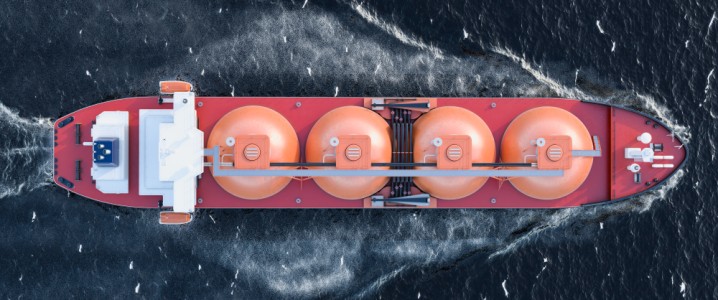
San Francisco — With US liquefied natural gas exporters set to capture windfall profits as the US/Israel and Iran war in the Middle East widens, a new brief from Rainforest Action Network warns that these short-term profits do not hide the long-term financial risks in the sector. The report gives evidence as to how these structural risks are independent of any geopolitical disruption and might intensify with time, with Venture Global as a central illustration despite its recent FID status with its latest project, CP2.
The brief, Doubling Down on Sinking Ground: The Financial Risks of US Gulf Coast LNG Export, synthesizes data from the IEA, S&P Global, Goldman Sachs, Fitch Ratings, BloombergNEF, IEEFA and others to expose four interlocking risk categories:
- Market oversupply: US export capacity is on track to double by 2030. BloombergNEF forecasts supply exceeding demand from 2027–2030. Goldman Sachs warns US LNG exports could become “uneconomic to flow” by 2028–29. Meanwhile, experts project medium-term demand to soften across Europe, Japan, South Korea, and China. High prices in the near term may incentivize Asian economies, especially, to build renewable infrastructure rather than depend on foreign oil & gas, intensifying oversupply scenarios.
- Litigation exposure: Venture Global LNG, an aggressive expander in the sector, faces potential arbitration damages approaching $10 billion from disputes with BP, and several other un-named clients after allegedly diverting contracted gas to high-margin spot sales. Fitch and S&P revised their outlooks to “negative” in October 2025. The company’s stock has shed about half its value since the firm’s January 2025 IPO.
- Physical climate risk: Gulf Coast LNG infrastructure is concentrated in some of the most exposed regions to operational flooding risk. Cameron Parish, home to Venture Global’s Calcasieu Pass terminal and its under construction Calcasieu Pass 2 terminal, ranks #1 nationally and 96.4% of physical infrastructure is already at flood risk today.
- Insurance retreat: Major insurers including Munich Re and Generali began excluding LNG terminals from coverage. Venture Global discloses it relies partly on a captive insurance subsidiary for hurricane coverage which means this highly-leveraged company may be effectively self-insuring against potentially billion-dollar weather disruption events.
This article was originally posted at sweetcrudereports.com
Be the first to comment