 Precious Anga
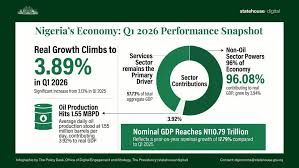
Lagos — Nigeria’s oil sector accounted for 3.92 per cent of the country’s real Gross Domestic Product (GDP) in the first quarter of 2026, reflecting a slight year-on-year dip despite modest improvement in output growth, according to the National Bureau of Statistics (NBS).
The latest GDP report released on May 25 showed that the oil sector’s share slipped marginally from 3.97 per cent recorded in the same period of 2025, though it rose from 2.87 per cent in the previous quarter of 2025.
The data underscores Nigeria’s continuing struggle to balance improved crude production with its declining overall weight in the national economy, as the non-oil sector continues to dominate growth.
According to the NBS, the oil sector recorded a real year-on-year growth of 2.57 per cent in Q1 2026, an improvement of 0.70 percentage points compared to 1.87 per cent in Q1 2025.
However, production performance weakened when measured against output levels, with Nigeria producing an average of 1.55 million barrels per day (mbpd) during the quarter. This was lower than 1.62 mbpd recorded in Q1 2025 and slightly below the 1.58 mbpd posted in Q4 2025.
The figures highlight persistent volatility in Nigeria’s upstream sector, even as government efforts continue to stabilise production and attract investment.
Despite the oil sector’s modest contribution, Nigeria’s overall economy recorded stronger performance. Real GDP grew by 3.89 per cent year-on-year in Q1 2026, up from 3.13 per cent in the corresponding period of 2025.
Growth was largely driven by the non-oil economy, with agriculture, industry, and services all posting improved or stable performances during the period.
The industry sector grew by 3.50 per cent, slightly higher than 3.42 per cent recorded in Q1 2025, while the services sector expanded by 4.31 per cent, compared to 4.33 per cent in the same period last year.
The services sector remained the backbone of the Nigerian economy, contributing 57.73 per cent of total GDP in Q1 2026, a marginal increase from 57.50 per cent in Q1 2025.
Overall, the non-oil sector maintained overwhelming dominance, accounting for 96.08 per cent of real GDP, driven by telecommunications, crop production, trade, manufacturing, financial services, real estate, construction, and transport activities.
The figures reinforce a long-standing reality: Nigeria’s economy is increasingly leaning on non-oil activities, even as crude oil remains a key foreign exchange earner and fiscal anchor.
The latest performance also comes amid growing global economic uncertainty. The International Monetary Fund (IMF) recently trimmed Nigeria’s 2026 growth forecast to 4.1 per cent, citing geopolitical tensions and weaker global demand conditions.
The IMF also warned of a broader slowdown in global growth, projecting world output to ease from 3.4 per cent in 2025 to 3.1 per cent in 2026, before a mild recovery.
For Nigeria, analysts say the combination of unstable crude output, external shocks, and domestic structural challenges continues to shape a fragile but gradually diversifying economic outlook.
This article was originally posted at sweetcrudereports.com
Be the first to comment